Rakes
JURAS
301 DN - 456 DN
-
DN three-point headstock with follow-up device as standard
-
Neat raking thanks to a wide variety of possible settings
-
Durable FELLA rake head with enclosed design
|
 300 SERIES 300 SERIES
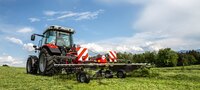
The single-rotor rakes with follow-up device from the 300 series are outstanding due to their low weight, their sturdy design, their ease of handling and their versatile use. These rakes can therefore be used with a tractor performance level of as low as approx. 23 hp. |
 400 SERIES 400 SERIES
The 400 series differs from the 300 series due to its larger-dimensioned rake head and larger working widths. With up to 12 tine arms and 48 tines, tidy and even raking is always guaranteed for working widths of up to 4.50 m. |
|
BROAD GAUGE CHASSIS FOR OPTIMUM GROUND ADAPTATION
The broad gauge chassis guarantees optimum ground adaptation of the single-rotor rake and very good efficiency on slopes.
|

THE RAKE IS ALWAYS IN VIEW THANKS TO THE SWATH POSITIONING ON THE RIGHT
The FELLA single-rotor rakes place the swath to the right, which ensures better ergonomics and a better overall view because all the tractor operating elements are also on the right-hand side.
|

INFINITELY ADJUSTABLE CLOTH
The spring-mounted cloth can be folded into the transport position very easily. The swath width can be adjusted individually. |
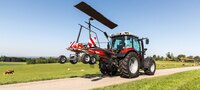
 CONVENIENT TRANSPORT THANKS TO HORIZONTAL STORAGE OF THE TINE ARMS CONVENIENT TRANSPORT THANKS TO HORIZONTAL STORAGE OF THE TINE ARMS
All the tine arms can be effortlessly removed and are stored horizontally. This significantly reduces the transport width and the risk of accidents. |